
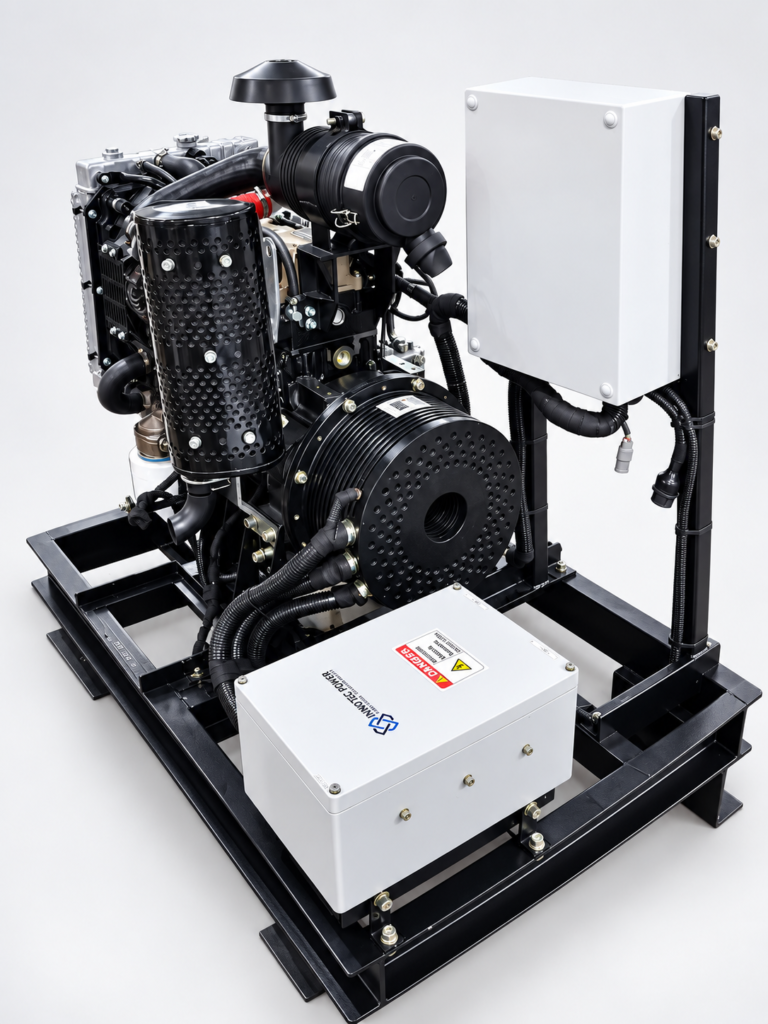
An engine-mounted 72 V generator puts a permanent magnet alternator directly on the prime mover you already have, in place of a conventional alternator and its rectifier. Innotec Power winds these heads for a 72–84 VDC output, which is the charging window of a 72 V battery bank, so the head feeds the bank without an inverter stage and without a separate charger.
The construction is the same across the range: brushless and bearing-less, with no slip rings, no exciter and no diodes inside the machine. On flywheel-mounted builds the rotor runs on the engine’s own bearings, which removes the last consumable from the alternator entirely.
What Innotec Power builds at 72 V
72 V heads are built in three drive configurations. The flywheel-mounted units are the same 310-series machines used inside the 14 kW and 25 kW complete DC generator sets, supplied on their own when you are mounting to your own engine.
| Drive | Output | Speed | Notes |
|---|---|---|---|
| Flywheel mounted, 310 series | 14 kW | 1,800–3,000 rpm variable | As fitted to the DCGO-14 set |
| Flywheel mounted, 310 series | 25 kW | 1,500–2,600 rpm variable | As fitted to the DCGO-25 set |
| Belt driven with DC AVR | 10 kW | 3,000 rpm | 84 VDC, two-to-one speed range |
| Belt driven with DC AVR | 15 kW | 3,000 rpm | 84 VDC, two-to-one speed range |
| Belt driven with DC AVR | 25 kW | 3,000 rpm | 84 VDC, two-to-one speed range |
| 255-DZ72-062, PTO or belt | 6 kW | 3,300 rpm | Flange or foot, 24 kg |
| 255-DZ72-070, PTO or belt | 7 kW | 3,800 rpm | Flange or foot, 24 kg |
Duty points between and around these are wound to order — the frames run from the 145 series up to the 360, and the winding is chosen from your speed and voltage rather than picked off a shelf.
Output and charging window
At 72 V the current is a third of what the same power costs at 24 V, which is most of the reason to specify this bus. A 14 kW head delivers roughly 170–195 A across the 72–84 V window, and a 25 kW head roughly 300–345 A. Cable, glands, fuses and contactors all come down accordingly.
Output can be configured two ways. With a regulator the head holds a constant terminal voltage, which suits a fixed DC load. Without one it is set to a charging range and taken straight to the bank, with engine or drive speed varied to follow the charge curve. Peak efficiency is engineered above 90%, and the machines are built for high vibration, high ambient temperature and continuous duty.
Starter/generator duty
The same machine can be specified to work in both directions. In starter/generator duty it cranks the prime mover, switches to generation once running, and recovers energy under braking in hybrid drivelines. That removes the separate starter motor and its ring gear, and it takes the starting torque demand off the engine. It is worth raising early — the winding and the controller are chosen differently for dual-direction duty.
Specifying a 72 V head
To quote a 72 V head we need the duty point in kW, the shaft speed or speed range, the mounting interface (flywheel diameter and bolt pattern, SAE housing, J609 face or foot), the cooling available, and whether you want a temperature sensor and position feedback. Tell us the battery chemistry too, because it sets the charging window inside the 72–84 V range.
Related: the complete 72 V DC generator sets, the 72 V PTO generator range, 48 V and 96 V engine-mounted heads, and the DC generator head overview. The same 72 V frames also run as motors across the 72 V motor range.
Frequently asked questions
| What voltage does a 72 V engine-mounted generator put out? | 72 to 84 VDC. Set as a charging range for direct battery connection, or held at a constant terminal voltage with a regulator. |
|---|---|
| Does it need its own bearings? | No. Flywheel-mounted heads run on the engine’s bearings, so there is nothing in the alternator to grease or replace. Belt and PTO driven units carry their own. |
| Can it start the engine as well as charge? | Yes, as a starter/generator. It cranks the prime mover, switches to generation, and can recover braking energy in a hybrid driveline. Specify it up front, as the winding and controller differ. |
| How much power can you build at 72 V? | Standard offerings run from 6 kW to 25 kW. Larger duty points are wound to order across the 145 to 360 frames. |
| What do you need to quote one? | Duty point in kW, shaft speed or range, the mounting interface, cooling available, and the battery chemistry that sets the charging window. |