
A 72V DC generator is more than just another power source—it’s a high-efficiency solution designed for applications where reliability, compactness, and performance truly matter. At Innotec Power, we design and manufacture 72 volt DC generators that excel in mobile, stationary, and hybrid power applications. Whether you need to charge a large battery bank, provide backup power for renewable energy systems, or integrate a generator into an advanced hybrid vehicle, our solutions deliver dependable performance in the most demanding environments.
Our 72V generator heads can be configured for constant terminal voltage with a regulator or adjusted to a charging voltage range for direct battery integration. This flexibility ensures that your system works seamlessly—whether you’re powering heavy-duty machinery or supporting an off-grid installation.
Complete 72 V DC generator sets
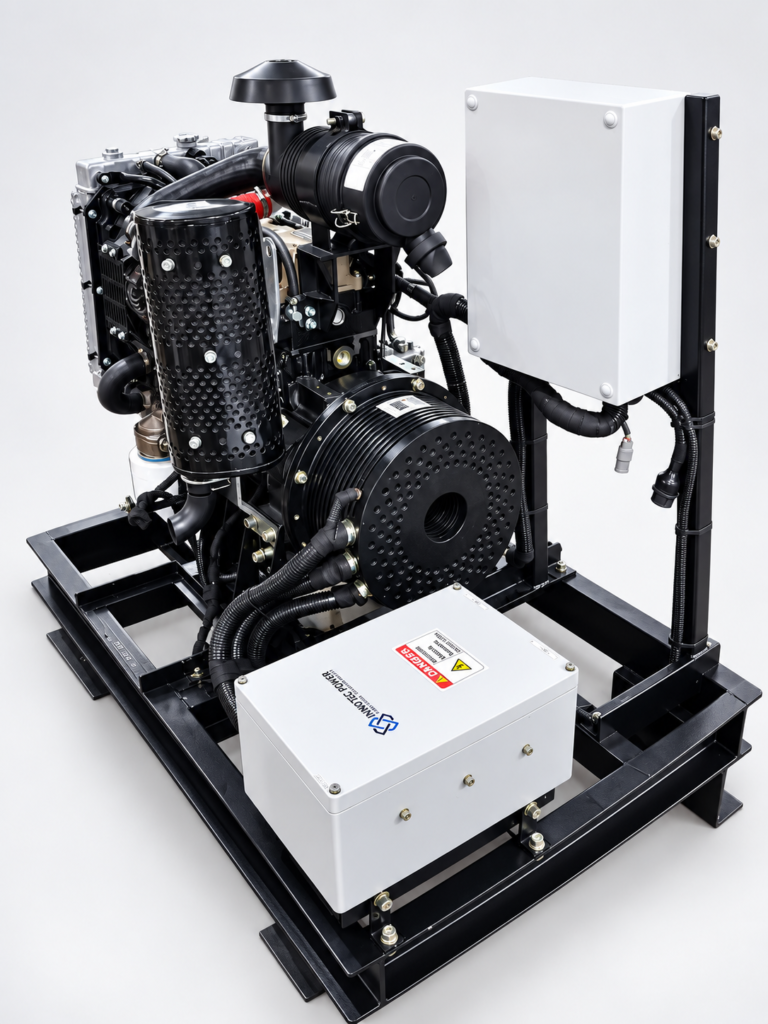
The complete 72 V sets are the same machines Innotec Power builds at 48 V, wound and configured for a 72–84 VDC charging range. Engine, permanent magnet alternator, variable-speed controller and frame ship on one skid, wired and tested. The alternator is flywheel-mounted with no generator bearings, no slip rings and no exciter.
| Model number | DCGO-14-72-KSD1403TC-000 | DCGO-25-72-KDI1903TC-000 |
|---|---|---|
| DC output | 14 kW | 25 kW |
| Nominal bus | 72 VDC | 72 VDC |
| Charging range | 72–84 VDC | 72–84 VDC |
| Output current | approx. 170–195 A | approx. 300–345 A |
| Engine | Kohler KSD1403TC, 3-cylinder turbocharged, liquid cooled | Kohler KDI1903TC, 3-cylinder, liquid cooled |
| Speed range | 1,800–3,000 rpm variable | 1,500–2,600 rpm variable |
| Dimensions (L×W×H) | 1,200 × 800 × 1,200 mm | 1,500 × 1,000 × 1,200 mm |
| Weight | 350 kg approx. | 585 kg approx. |
| Peak efficiency | Over 93% | Over 93% |
Both are available open-frame, with an integrated 200, 400 or 600 litre tank, or in a sound-attenuated enclosure. Spark-ignition versions of the same platforms are on the gas DC generator page, and standalone battery-bank and solar-hybrid installations are covered under DC generators for off-grid systems.
72 V PTO generators
Where a tractor or an existing power take-off is already on site, the alternator runs from the PTO shaft instead of its own engine. Two 72 V units are built as standard.
| Model | Rated power | Rated speed | Voltage |
|---|---|---|---|
| 255-DZ72-062 | 6 kW | 3,300 rpm | 72 VDC |
| 255-DZ72-070 | 7 kW | 3,800 rpm | 72 VDC |
Both are belt-driven permanent magnet alternators with no brushes and no AVR. Full detail is on the 72 V PTO generator page.
72 V generator heads and machines
If the application already has an engine, the alternator is supplied on its own as a DC generator head and matched to the flywheel or mounting face. Innotec Power builds 72 V engine-mounted heads as a standard product, from 6 kW to 25 kW, in flywheel, belt and PTO drive. The full range, the 72–84 VDC output behaviour and the starter/generator option are on the 72 V engine-mounted generator page.
The same 72 V machines run as motors. The 72 V motor range covers 351 models across the 145, 235, 255 and 360 frames, and the PMSM range explains the frame and winding conventions used in both directions.
Why Choose a 72 Volt DC System?
A 72V battery bank strikes the perfect balance between efficiency, current handling, and scalability. Compared to 24V or 48V systems, 72 volt DC generators deliver the same power with less current, which means reduced wiring losses, smaller conductor sizes, and faster charging. This makes them a popular choice for:
Electric and hybrid construction machinery
Industrial material handling equipment
Marine auxiliary power systems
Off-grid agricultural equipment
Backup for solar and hybrid installations
Military and defence applications
For example, in a solar hybrid setup, a 72V generator can supplement renewable power when sunlight is low, ensuring batteries are consistently charged without oversizing the system.
Key Advantages of 72V Over Lower Voltage Systems
Upgrading to a 72V DC generator brings multiple technical and operational advantages. Let’s explore these in detail:
1. Faster Charging with Lower Current
For the same power level, a 72V system draws significantly fewer amps compared to a 24V or 48V system. For example:
10 kW at 72V → ~140 amps
10 kW at 24V → ~400 amps
Lower current means faster charging times and less heat loss in cables, ensuring more power reaches your batteries or load.
2. Smaller Conductor Sizes
Reduced amperage allows the use of smaller gauge wiring. This not only cuts material costs but also saves space and reduces overall system weight—critical for mobile or vehicle-mounted setups.
3. Reduced Heat and Cooling Requirements
Since current flow is lower, electronics and power controllers run cooler. This can minimize the need for bulky heatsinks, additional cooling fans, or liquid cooling systems.
4. Improved System Efficiency
Less heat loss and smaller cable runs translate to better overall system efficiency. More of the generated energy is delivered where it’s needed—powering equipment or charging batteries.
72V DC Starter/Generator Technology
One of the standout features we offer is starter/generator functionality. Our 72V DC generator heads can be designed to perform double duty:
Act as a starter motor to crank the engine or prime mover
Switch to generator mode once the engine is running
Provide regenerative braking or energy recovery in hybrid applications
This dual-purpose capability reduces the need for separate starter motors, simplifying the system while saving weight, cost, and installation space.
Where 72 Volt DC Generators Excel
The versatility of our 72V generator heads makes them suitable for diverse environments:
Electric & Hybrid Vehicles – Providing both propulsion support and battery charging.
Material Handling Systems – Ensuring consistent performance for forklifts and warehouse vehicles.
Marine Power Systems – Delivering auxiliary or emergency power offshore.
Off-Grid Renewable Installations – Supporting solar arrays during cloudy days or at night.
Agricultural Machinery – Powering irrigation pumps, tractors, and harvesters in remote areas.
Defense & Military Use – Running reliably in rugged, high-vibration, and extreme-temperature conditions.
Considerations When Designing a 72V DC System
While 72V brings many benefits, there are also important design considerations:
Component Voltage Matching
Not all components—like inverters, controllers, and auxiliary devices—are readily available for 72V systems. Working with a supplier like Innotec Power ensures all parts are matched for compatibility.
Step-Down Converters
Some onboard electronics will still require lower voltages (e.g., 12V or 24V). DC-DC step-down converters are often needed to power these components efficiently.
Early System Planning
It’s best to define motors, controllers, and accessories early in the design phase to avoid voltage mismatch and ensure smooth integration.
Why Innotec Power is the Right Choice
When you choose Innotec Power for your 72 volt DC generator, you get more than a product—you get a complete engineering solution:
Custom Voltage & Output Ranges – Tailored to your system’s requirements
Heavy-Duty Engineering – Designed for high vibration, high temperature, and continuous operation
Starter/Generator Integration – Combine starting and generation in a single compact unit
Renewable Energy Compatibility – Perfect for solar, wind, and hybrid energy setups
Expert Application Support – From voltage selection to full system integration guidance
We also manufacture both engine-mounted 72V generators and PTO-driven 72V generators, giving you options for fixed or mobile installations.
Request a Quote Today
24 V, 48 V or 72 V — choosing the bus
The bus voltage is chosen by what the load already runs at, and after that by current. The same power costs proportionally more copper the lower the voltage, which is why the 14 kW set looks so different across the three buses:
| 14 kW set at | Charging range | Output current |
|---|---|---|
| 24 V | 24–30 VDC | approx. 470–500 A |
| 48 V | 48–60 VDC | approx. 260 A |
| 72 V | 72–84 VDC | approx. 170–195 A |
At 72 V the same 14 kW flows at roughly a third of the 24 V current, so conductors, connectors, fuses and contactors all come down a size or more. That is the argument for 72 V on electric and hybrid construction machinery, material handling and larger off-grid banks. For vehicle work specifically, the same machines are supplied as a 72 V range extender — charging the traction pack on the move, in 5, 15 and 25 kW frames. Above this, the 96 V range and the wider DC generator range cover 300 V, 400 V and 600 V buses for traction and DC-microgrid work.
Frequently asked questions
| What voltage does a 72 V DC generator actually output? | 72 to 84 VDC. The window is programmable so the set follows the charging profile the battery manufacturer specifies rather than holding one fixed voltage. |
|---|---|
| How much current does a 72 V DC generator deliver? | Roughly 170 to 195 A from the 14 kW set and 300 to 345 A from the 25 kW set, across the 72 to 84 V charging window. |
| Is the 72 V set a different machine from the 48 V set? | No. It is the same engine, frame and alternator platform, wound and configured for a 72 to 84 V charging range instead of 48 to 60 V. |
| Why choose 72 V over 48 V? | Current. The same 14 kW flows at about 180 A at 72 V against about 260 A at 48 V, so cable, connectors and protection all come down a size. It suits electric and hybrid machinery and larger battery banks. |
| Can a 72 V generator charge the battery bank directly? | Yes. The output is regulated DC connected to the bank without an inverter or an external charger, and engine speed is varied to hold the charging voltage. |