
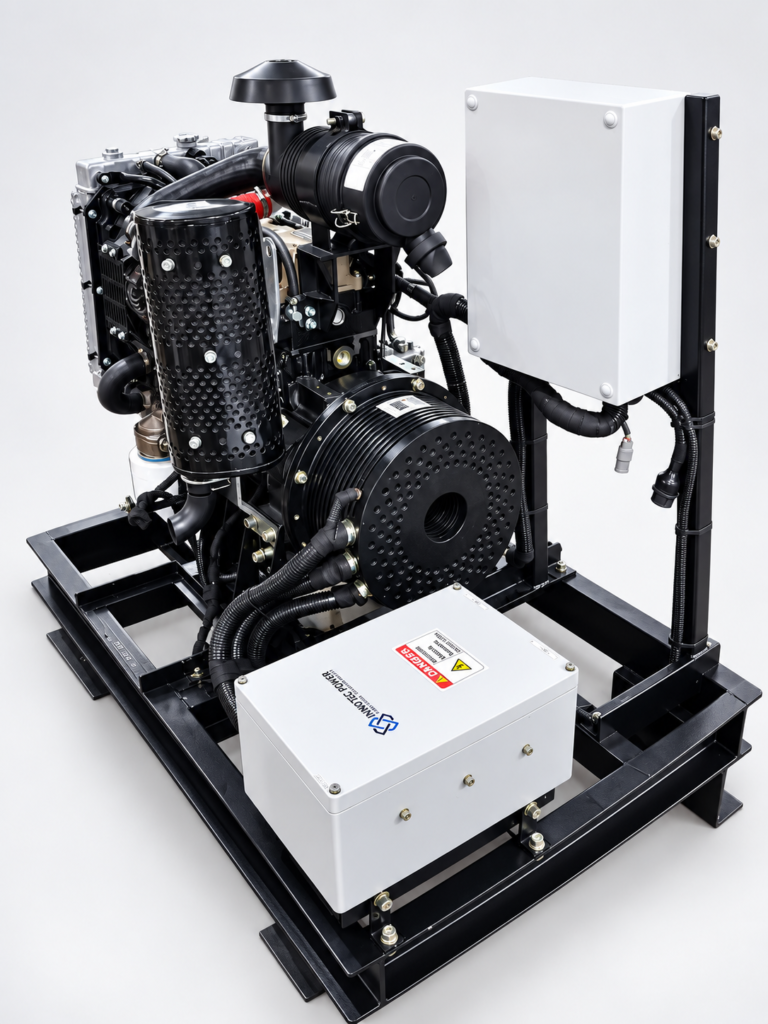
A range extender is not a generator bolted to a vehicle. It is a charging source that has to live inside a vehicle’s packaging, weight budget and electrical architecture — which is why Innotec Power builds the 48 V units around a flange mount and a spline shaft rather than a foot and a keyway. They are designed to be integrated, not installed.
The machine is a permanent magnet alternator driven by a small combustion engine, feeding the vehicle’s 48 V pack directly through a passive rectifier. There is no inverter stage, no synchronous speed to hold and no drivetrain connection — the engine exists only to make charge. Innotec first tested DC gensets built on its own PMAs in 2014, and the line has been through third-party testing since.
The 48 V range extender units
Two 48 V units are built as standard. Both run at 3,000 rpm, both are air cooled, and both are flange mounted with a spline shaft for direct integration into an EV or hybrid driveline.
| Frame | 255-DZ | 345-EZ |
|---|---|---|
| DC output | 5 kW | 15 kW |
| Rated speed | 3,000 rpm | 3,000 rpm |
| Bus voltage | 48 V (also built at 72 V) | 48 V (also built at 72 V) |
| Output current | approx. 90 A | approx. 250–310 A |
| Cooling | Air | Air |
| Mounting | Flange | Flange |
| Shaft | Spline | Spline |
| Designed for | High-speed operation | EV and hybrid integration |
Where the whole unit is wanted as a finished package rather than an alternator to integrate, the 5 kW and 14 kW DC generator sets ship complete with engine, controller and frame — DCGO-05-48-KD440-000 at 85 kg in a 700 × 600 × 580 mm envelope, and DCGO-14-48-KSD1403TC-000 at 14 kW.
Starter-generator: one machine, both jobs
This is the feature worth designing around, and most range extender suppliers cannot offer it. The same permanent magnet machine can be programmed to run as a starter motor for its own engine, then switch to generating once it is running.
On a vehicle that matters twice over: it removes the separate starter motor, and it removes the starter battery that would otherwise be carried purely to crank an engine that only runs part of the time. Fewer parts, less weight, and one less thing to fail on a unit that may sit idle for days between duty cycles. It has to be specified up front, because the winding and the controller are chosen differently for dual-direction duty. See starter generators.
What the permanent magnet design buys you
- Power to weight. The PM alternator is substantially smaller than a conventional machine of the same rating, which is the whole reason this fits a vehicle at all.
- Overload protection built in. Output current is limited to a set value for each power and voltage rating, so neither the alternator nor the engine can be pulled past its design point by a depleted pack.
- No brushes, no slip rings, no AVR. Rare earth NdFeB magnets and Class H copper windings, with a bearing-less or direct-mounted rotor on most builds — fewer components, fewer failure modes, and nothing to service between engine intervals.
- Charging profile, not a fixed voltage. The controller follows the curve the pack chemistry needs rather than holding one terminal voltage, which is what protects cycle life on a pack that gets topped up mid-journey.
- Quiet and fuel-flexible. Engine speed follows the charging demand instead of being pinned to make 50 or 60 Hz, and the unit can be paired with petrol, diesel or LPG micro-engines.
Where 48 V range extenders go
48 V is the volume bus in light electric mobility, and that is where these units mostly go:
- Electric two- and three-wheelers, and last-mile delivery fleets that cannot afford charge downtime mid-shift
- Light commercial EVs and utility vehicles on a 48 V platform
- Material handling and warehouse equipment running extended shifts
- Mobile robotics and autonomous ground equipment
- Small electric boats and marine house banks — see DC generators for hybrid vehicles
- Off-grid and mobile power where the pack is the primary source and the engine is the backstop
48 V or 72 V?
Stay at 48 V when the vehicle already runs at 48 V. Nothing has to be re-rated, the controllers and converters are the easiest to source at this voltage, and below about 10 kW the current is manageable.
Move to 72 V when output goes above roughly 10 kW or when cable weight starts to matter. The 15 kW unit draws around 280 A at 48 V against about 195 A at 72 V — for the same power, which on a vehicle is copper you are carrying for the life of the machine. The 72 V line also adds a 25 kW frame that has no 48 V equivalent.
Background on the bus itself is on the 48 V DC generator page, and the full range across voltages on the DC generator hub.
Frequently asked questions
| What is a 48 V range extender? | A small combustion engine driving a permanent magnet alternator that charges a 48 V battery pack while the vehicle is running. It never drives the wheels — it works as an onboard charging station, so the pack can be sized for normal duty rather than worst-case range. |
|---|---|
| How much power do the 48 V units make? | 5 kW and 15 kW as standard, both at 3,000 rpm, which is roughly 90 A and 250 to 310 A at the pack. |
| Can it start its own engine? | Yes, as an option. The same machine can be programmed to crank the engine and then switch to generating, which removes the separate starter motor and the starter battery. Specify it up front — the winding and controller differ. |
| How does it mount? | Flange mounted with a spline shaft, air cooled. It is built to integrate into an EV or hybrid driveline rather than to sit on a frame as a separate unit. |
| 48 V or 72 V? | 48 V if the vehicle already runs at 48 V and output is below roughly 10 kW. 72 V above that, or where cable weight matters — the same 15 kW flows at about 195 A instead of 280 A. |
| Can I get it as a complete set instead of an alternator? | Yes. The 5 kW and 14 kW DC generator sets ship complete with engine, controller and frame, tested as one machine. |