
Reliable 24 V DC Generation for Industrial, Mobile & Off-Grid Power
Our 24 V DC generators (permanent magnet generators / PMGs) deliver up to 1,000 A of clean, regulated DC power. Designed by Innotec Power, these units outperform traditional alternators by running bearingless and variable-speed, making them ideal for engine-driven battery charging, EV range extenders, and heavy-duty electrical loads.
Available 24 V DC Generator Models
235-EZ24-175
Power: 5 kW
Speed: 2300 RPM
Voltage: 24-32 VDC
Mounting: J609, Shaft Driven
310-EZ24-350
Power: 10 kW
Speed: 2200 RPM
Voltage: 24-32 VDC
Mounting: Flywheel Driven
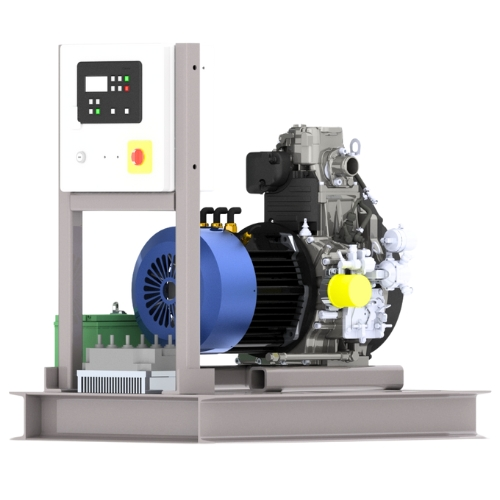
DCGO-05-24-KD440-000
Power: 5 kW
Speed: 3000 RPM
Voltage: 24 VDC
Mounting: Flywheel Driven
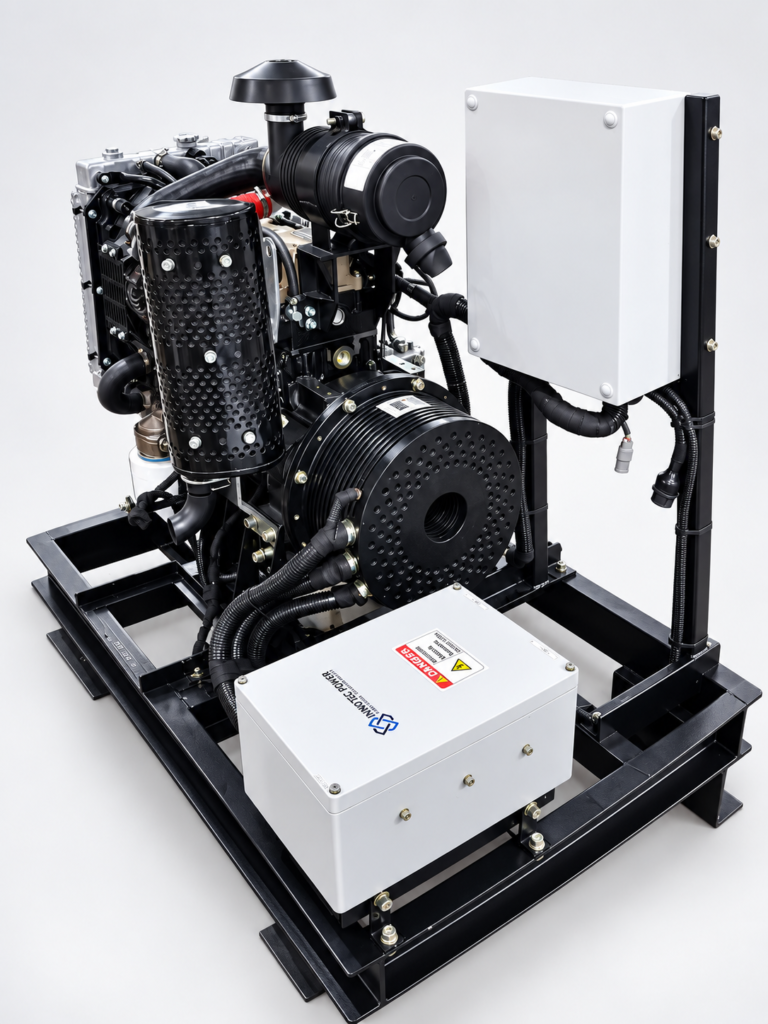
DCGO-14-24-KSD1403TC-000
Power: 14 kW
Speed: 3000 RPM
Voltage: 24 - 30 VDC
Mounting: Flywheel Driven
Why Choose Our 24 V PMGs
- Bearingless Rotor Design – No generator bearings to maintain; couples directly to the engine for long service life.
- Variable-Speed Performance – Efficient DC output across a broad RPM range; pair with gasoline or diesel engines.
- Up to 1,000 A Continuous Output – High-current capability for demanding 24 V systems.
- MIL-STD Ripple Tested – Clean DC power protects sensitive electronics and inverter systems.
- Flexible Integration – Available as stand-alone generator heads or complete engine + generator + controller packages.
Technical Highlights
Parameter |
Nominal Output |
Current Rating |
Output Power |
Cooling |
Engine Options |
Ripple Compliance |
Design |
Mounting |
Specification |
24 V DC |
Up to 1,000 A continuous |
Up to 24 kW (engine-dependent) |
Air or optional liquid cooling |
Gasoline or Diesel |
Tested to MIL-STD-1275F |
Bearingless, permanent-magnet, variable-speed |
SAE engine flange or custom |
Typical Uses
- Off-highway & construction equipment
- Marine & workboat DC power systems
- EV/hybrid auxiliary power units & battery charging
- Remote site/telecom backup
- Military & defence vehicles
- Mobile service trucks & welding power
Innotec Power Advantage
- Proven PMG Technology – Over two decades designing PMSM/BLDC motors & generators.
- Flexible Supply Options – Heads only or fully integrated engine-generator packages.
- Custom Integration – Enclosures, passive or controlled rectifiers, auxiliary outputs.
- Global OEM Adoption – Trusted in demanding industrial and defense applications.
Need reliable 24 V DC power?
Complete 24 V diesel generator sets
Two complete 24 V sets are built and shipped as finished machines — engine, permanent magnet alternator, controller and frame on one skid, wired and tested. Both use a flywheel-mounted PMA with no generator bearings and no exciter, so the only rotating wear parts in the set are the engine’s own.
| Model | DCGO-05-24-KD440-000 | DCGO-14-24-KSD1403TC-000 |
|---|---|---|
| DC output | 5 kW | 14 kW |
| Nominal bus | 24 VDC | 24 VDC |
| Alternator output | 24–30 VDC | 24–30 VDC |
| Engine | Kohler KD440, air-cooled single cylinder | Kohler KSD1403TC, 3-cylinder turbocharged, liquid cooled |
| Speed | 3,000 rpm | 1,800–3,000 rpm variable |
| Drive | Flywheel mounted | Flywheel mounted |
| Output connector | — | Amphenol G2 series, 500 A |
| Dimensions (L×W×H) | — | 1,200 × 800 × 1,200 mm |
| Weight | — | 350 kg approx. |
Both are available open-frame, with an integrated 200, 400 or 600 litre tank, or in a sound-attenuated enclosure. Spark-ignition versions of the same platform are covered on the gas DC generator page, and the range steps up to the 25 kW DC generator on the larger KDI1903TC.
How a 24 V permanent magnet generator charges a bank
A 24 V bus trades voltage for current. At 14 kW the set delivers roughly 470–500 A across the 28–30 V charging window, and the 5 kW set around 180–200 A. That is the reason the output connector is a 500 A Amphenol G2 rather than a terminal block, and the reason cable sizing matters more on a 24 V installation than on a 48 V one — the same power costs four times the conductor cross-section at half the voltage over the same run.
Engine speed is varied to regulate voltage rather than held at a fixed 1,500 or 1,800 rpm to hold frequency. The controller runs a PID loop against the charging characteristic, so the set throttles back as the bank approaches absorption instead of burning fuel to hold a synchronous speed. There is no inverter stage and no rectifier loss between the alternator and the battery.
24 V or 48 V — choosing the bus
Specify 24 V when the load already is 24 V: vehicle and equipment electrics, military and defence platforms, workboat and marine DC systems, telecom cabinets built on a 24 V plant. The set charges the existing bank directly and nothing on board has to be re-rated.
Move to 48 V when the run between the set and the bank is long, when the bank is large, or when the power drawn is above roughly 10 kW and conductor cost starts to dominate. At 48 V the same 14 kW flows at about half the current, which halves the copper. Beyond that the 72 V range carries the same 14 kW and 25 kW platforms at roughly a third of the 24 V current, and the whole DC generator range covers 300 V, 400 V and 600 V buses for traction and DC-microgrid work.
24 V generator heads and PTO options
If the application already has an engine, the alternator can be supplied on its own. The 24 V engine-mounted generator range bolts a PMA to an existing flywheel or J609 face, from 5 kW at 2,300 rpm to 10 kW at 2,200 rpm. Tractor and truck installations can take the 24 V PTO generator instead. For standalone battery-bank and solar-hybrid installations, see DC generators for off-grid systems.
Frequently asked questions
| How much current does a 24 V DC generator produce? | Current is the rated power divided by the bus voltage. A 5 kW 24 V set delivers roughly 180–200 A and a 14 kW set roughly 470–500 A across the 28–30 V charging window. |
|---|---|
| Can it charge a battery bank directly? | Yes. The output is regulated DC and is connected to the bank without an inverter or an external charger. The controller follows the charging curve and reduces engine speed as the bank fills. |
| Is a 24 V DC generator better than an AC set with a rectifier? | For a DC load it removes a conversion stage. Peak efficiency is engineered above 93%, engine speed is free to vary, and there are no slip rings, no exciter and no diodes in the alternator to fail. |
| What is the largest 24 V generator you build? | Up to 24 kW at 24 V, engine-dependent, with continuous current capability to 1,000 A. |