
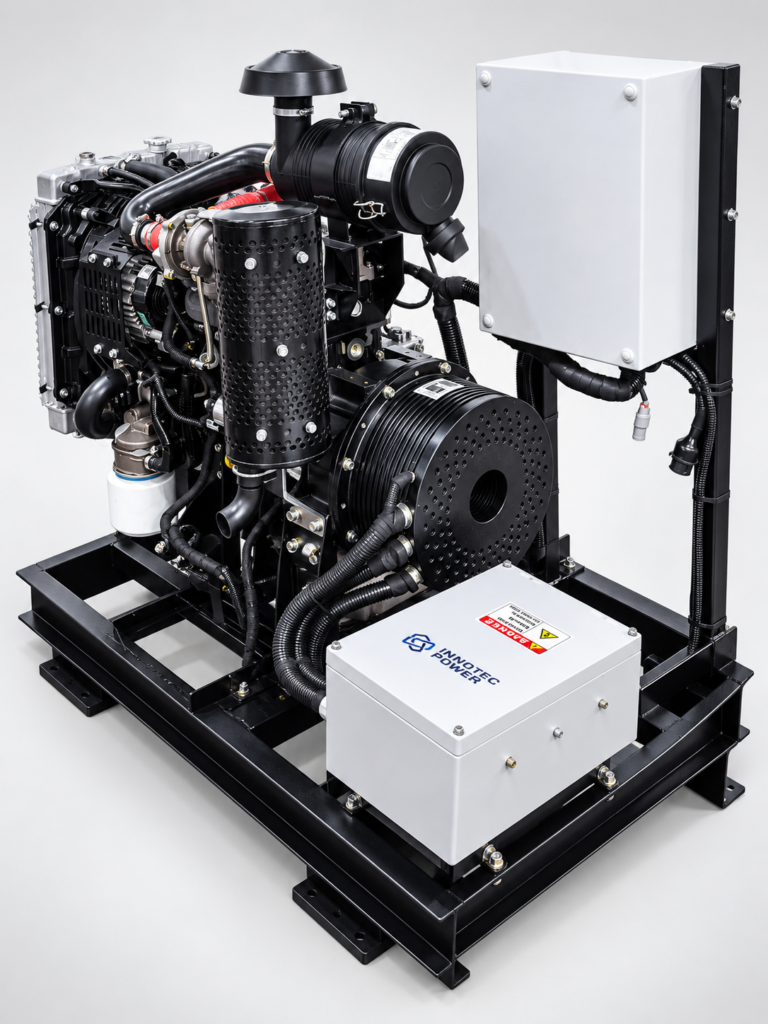
96 V is where the Innotec Power DC range stops being about battery charging alone and starts carrying real machine loads. The charging window is 96–120 VDC, and it is the bus most often specified when a single set has to run hydraulics, traction assist or an auxiliary power unit as well as keeping a bank topped up. Everything here is permanent magnet and variable speed — there is no exciter, no slip ring and no rectifier stage between the machine and the DC bus.
Complete 96 V DC generator sets
The complete sets are the DCGO diesel platforms wound for a 96 V bus. Both ship as finished machines on a single skid, engine and alternator and controller wired and tested together.
| Model number | DCGO-14-96-KSD1403TC-000 | DCGO-25-96-KDI1903TC-000 |
|---|---|---|
| DC output | 14 kW | 25 kW |
| Nominal bus | 96 VDC | 96 VDC |
| Charging range | 96–120 VDC | 96–120 VDC |
| Output current | approx. 120–145 A | approx. 210–260 A |
| Engine | Kohler KSD1403TC, 3-cylinder turbocharged, liquid cooled | Kohler KDI1903TC, 3-cylinder, liquid cooled |
| Speed range | 1,800–3,000 rpm variable | 1,500–2,600 rpm variable |
| Dimensions (L×W×H) | 1,200 × 800 × 1,200 mm | 1,500 × 1,000 × 1,200 mm |
| Weight | 350 kg approx. | 585 kg approx. |
Open-frame, integrated 200/400/600 litre tank, or sound-attenuated enclosure. Spark-ignition builds are covered on the gas DC generator page.
96 V generator heads and PTO units
Two mounting styles are offered for customers supplying their own prime mover. The flywheel-mounted 360 series is the largest single head Innotec Power builds at any voltage.
| Model | Output | Speed | Output voltage | Drive |
|---|---|---|---|---|
| 360-HC96-350 | 40 kW | 2,600 rpm | 96–120 VDC | Flywheel |
| 255-AEZ96-125 | 18 kW | 2,200 rpm | 96 VDC | PTO / belt |
| 255-DE96-045 | 7 kW | 2,800 rpm | 96 VDC | PTO / belt |
| 255-DZ96-045 | 5 kW | 3,000 rpm | 96 VDC | PTO / belt |
The 18 kW PTO unit is the largest belt-driven machine in the catalogue at any bus voltage, which is a direct consequence of the higher voltage: at 96 V it moves 18 kW on a conductor a 24 V machine would need for about 4 kW. Full detail sits on the 96 V engine-mounted generator and 96 V PTO generator pages, and the DC generator head overview covers custom windings.
Where 96 V earns its place — and where it does not
The case for 96 V is arithmetic. A 25 kW set draws about 230 A on a 96 V bus against roughly 460 A at 48 V — half the current for identical output, which halves the copper, shrinks the connectors and takes a whole size out of the protection devices. On a mobile machine that shows up as weight saved rather than money.
Where it stops paying is component supply rather than physics. Below 96 V the market is full of ready-made controllers, converters and contactors; above it, at 300 V and up, there is a separate ecosystem built for traction. 96 V sits between the two, so the auxiliary side of the system usually needs deliberate selection rather than a catalogue pick. That is worth settling at design stage, not at commissioning.
If the load is below 10 kW or already runs at a lower bus, 24 V, 48 V and 72 V will be cheaper to integrate. Above 96 V, the DC generator range continues at 300 V, 400 V and 600 V.
96 V and auxiliary power units
The most common 96 V application is an auxiliary power unit: a compact engine and alternator carried on a truck, a specialist vehicle or a piece of off-highway plant, running cabin systems, hydraulics and hotel loads without idling the main engine. The reason 96 V suits it is duty rather than voltage — APU loads swing hard and often, and a variable-speed permanent magnet machine follows that swing by changing speed instead of dumping the difference as heat at a fixed 1,500 or 1,800 rpm.
The same argument covers hybrid drivelines, mobile light towers and larger marine house banks. See DC generators and auxiliary power units for the system view, and off-grid DC generators for standalone battery-bank installations.
Frequently asked questions
| What is the output voltage of a 96 V DC generator? | 96 to 120 VDC. The window is programmable to the battery chemistry, so the machine follows a charge curve rather than holding one fixed terminal voltage. |
|---|---|
| What is the largest 96 V generator you build? | The 360-HC96-350 flywheel-mounted head at 40 kW and 2,600 rpm. It is the largest single machine in the engine-mounted range at any bus voltage. |
| How much current does a 96 V set deliver? | Around 130 A at 14 kW, 230 A at 25 kW and 370 A from the 40 kW head, across the 96 to 120 V window. |
| Is 96 V harder to integrate than 48 V? | The generator is not, but the components around it can be. Off-the-shelf controllers and converters are easier to source at 48 V and 72 V, so the auxiliary side of a 96 V system needs selecting deliberately at design stage. |
| Can a 96 V set run an APU load rather than just charge? | Yes, and that is its most common use. Variable speed lets the machine track a swinging auxiliary load by changing engine speed rather than throwing away the difference at a fixed synchronous speed. |