
A base transceiver station runs on DC. The radios, the baseband unit and the site battery string all sit on a 48 V DC plant, and the industry convention for that plant is −48 V. Yet most backup sets on cell sites are AC machines with a rectifier bolted on afterwards — chosen because that is what was available, not because it suited the load. Every watt passes through an alternator built for 50 or 60 Hz, then a conversion stage, before it reaches a bus that wanted DC in the first place.
Innotec Power builds the generator as a DC machine. A permanent magnet alternator feeds a passive rectifier and the site battery bank directly, with no inverter stage and no synchronous speed to hold. The alternator is engineered above 93% efficient against less than 78% for the conventional alternator in an AC set, and because engine speed is free to follow the load rather than pinned at 1,500 or 1,800 rpm, the saving compounds at the part loads a telecom site actually runs at.
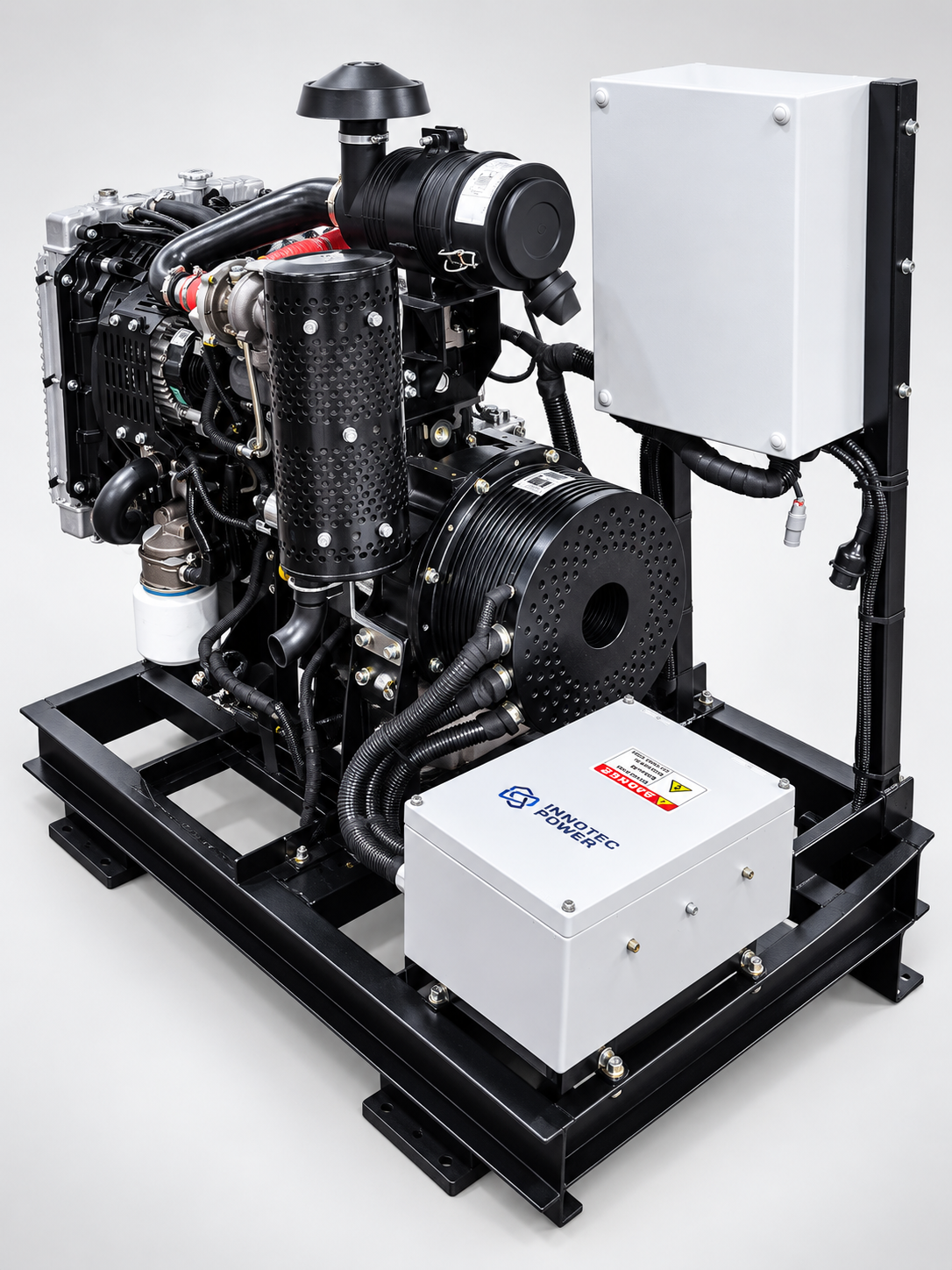
Telecom DC generator sets
Two complete sets cover most cell-site and small data-centre duty. Both are finished machines — engine, alternator, controller and frame on one skid, wired and tested.
| Model | DCGO-05-48-KD440-000 | DCGO-14-48-KSD1403TC-000 |
|---|---|---|
| DC output | 5 kW | 14 kW |
| Nominal bus | 48 VDC | 48 VDC |
| Alternator output | 56 VDC | 48–60 VDC |
| Output current | approx. 89 A | approx. 235–290 A |
| Engine | Kohler KD440/441, 1 cylinder, air cooled | Kohler KSD1403TC, 3 cylinder, turbocharged, liquid cooled |
| Engine max power | 7.4 kW | 18.4 kW |
| Fuel consumption | 240 g/kWh | 245 g/kWh |
| Speed | Fixed, 3,000 rpm | Variable, 1,800–3,000 rpm |
| Alternator | 255 series J609 PMA | 310 series flywheel-mounted PMA |
| Output connector | Amphenol Surlok series, 125 A | Amphenol Surlok series, 300 A |
| Dimensions (L×W×H) | 700 × 600 × 580 mm | 1,200 × 800 × 1,200 mm |
| Weight | 85 kg approx. | 350 kg approx. |
| Ambient range | −5 °C to 50 °C | −5 °C to 50 °C |
| Emissions | Tier 4, EU Stage V, CPCB IV, Bharat Trem Stage III | US Tier IV Final / EU Stage V |
At 85 kg and 700 mm long, the 5 kW set fits inside a standard site enclosure. Both are available open-frame, with an integrated 200, 400 or 600 litre tank, or sound-attenuated. Larger sites step up to the 25 kW set.
Fixed speed or variable speed
This is the decision that matters most on a telecom site, and it is not a question of which is better.
The 5 kW set runs at a fixed 3,000 rpm. A constant-speed engine gives a consistent output voltage with a simpler mechanical system, fewer things to drift and fewer things to fail. That is why fixed-speed sets remain the default on telecom, military and industrial sites where the load is steady and uptime matters more than the last few percent of fuel.
The 14 kW set varies between 1,800 and 3,000 rpm. The controller runs a PID loop against the charging characteristic and drops engine speed as the battery bank approaches absorption, instead of burning fuel to hold a speed the load no longer needs. On a site that cycles — charge, rest, charge — that is where the fuel goes. Against a conventional AC set the combined effect of the 93% alternator and load-following speed is around 15% lower fuel consumption.
Sites that cycle hard, or that run a solar hybrid where the genset only tops up, benefit from variable speed. Sites carrying a flat continuous load are usually better served by the fixed-speed machine.
What the permanent magnet alternator changes
- Efficiency above 93%, against under 78% for the wound-field alternator in a comparable AC set.
- No brushes, no slip rings, no exciter and no generator bearings. The rotor runs on the engine bearings on flywheel-mounted builds, so the alternator has no consumable parts at all — the single biggest saving on an unmanned site where a call-out costs more than the fuel.
- At least 30% smaller than the alternator it replaces, which is what lets a 5 kW set come in at 85 kg and fit an existing cabinet.
- Start-up under 10 seconds, so the bank is carried through the transfer without depth-of-discharge penalties.
- High variable frequency and low ripple, which matters because the same bus feeds the radios.
The controller
Both sets ship with a variable-speed DC genset controller running a precision PID loop matched to the battery chemistry, so the set follows the manufacturer’s charging curve rather than holding one fixed voltage. Protection covers overvoltage, overcurrent, overspeed, overheat, thermal and short circuit. For unmanned sites the relevant features are the remote ones:
- MODBUS communications for integration with site monitoring
- GSM SMS message on fault
- 100 event logs with time stamp and measurements
- Isolated volt–amp measurement
- ECU connection through J1939 CAN as an option
- Field-adjustable parameters
Hybrid and off-grid sites
Many of the sites that need this have no grid at all. A DC genset sits naturally alongside solar and a battery string because all three speak the same bus — there is no inverter in the middle arbitrating between them. The genset runs only when the state of charge calls for it, which on a well-sized hybrid site can mean a few hours a day rather than continuous running.
See DC generators for off-grid systems for the system view and DC generators for battery charging for the charging behaviour. Where wind is the better resource, Innotec also builds wind generators for remote power.
Other configurations
If the site already has an engine, the alternator can be supplied on its own as a DC generator head or a 48 V engine-mounted generator. The full range across bus voltages is on the DC generator hub, with dedicated pages for 24 V, 48 V, 72 V and 96 V. Spark-ignition versions are covered under gas DC generators.
Frequently asked questions
| Why use a DC generator on a telecom site instead of an AC set? | The site bus is already DC. A DC genset removes the conversion stage between the alternator and the battery string, runs an alternator engineered above 93% efficient against under 78%, and is free to vary engine speed with load instead of holding a synchronous speed to make 50 or 60 Hz nobody uses. |
|---|---|
| How much fuel does it actually save? | Around 15% against a comparable AC set, from the alternator efficiency and load-based variable speed combined. The gap widens at part load, which is where a cell site spends most of its time. |
| What size set does a BTS site need? | The 5 kW set delivers about 89 A at 56 VDC and suits a single cabinet. The 14 kW set delivers roughly 235 to 290 A across the 48 to 60 V window and suits multi-operator or multi-cabinet sites. Size to the charging current the bank needs, not to the radio load. |
| Fixed speed or variable speed for telecom? | Fixed speed for a steady continuous load, where simplicity and consistent voltage matter most. Variable speed where the site cycles or runs a solar hybrid, because the fuel saving comes from dropping engine speed as the bank fills. |
| Can it run unattended? | Yes. MODBUS communications, GSM SMS alerts on fault and 100 time-stamped event logs are standard, and the alternator has no brushes, slip rings or bearings to service between engine intervals. |